Keep looking!

Strange, isn’t it: We have more, much more to do than before Corona. We realized all books planned, even 3 additional titles. Everything has changed, all that has been learned in 27 years of publishing is totally new each day.—Are we prepared to the New? And wasn’t it exactly the New, the curiosity about »News« that inspired the founding of a… MORE


Authors & Books
Michael Schilar

Michael Schilar was born on October 19, 1959, in East Berlin. From 1981 to 1988, he studied philosophy and aesthetics at Humboldt University (under the influential teachers Wolfgang Heise and Gerd Irrlitz) . In 1988, he joined the Institute of Literary Studies at the Academy of Sciences of the GDR in 1988. He received his doctorate in 1989 with a thesis on the final act of Goethe’s »Faust II«.
After the fall of the Berlin Wall and the dissolution of the GDR Academy, he was integrated into a support program for former GDR scientists, and in the meantime (1991/92) he received a Thyssen scholarship in Munich (under Wolfgang Frühwald). 1994 to 1996, teaching position at the Institute for Cultural Studies at Humboldt University. From 1997, he worked on the »Goethe Dictionary« at the Berlin-Brandenburg Academy of Sciences, where he wrote more than 2,500 dictionary articles over a period of 29 years (including entries on »Herz« (heart), »Kraft« (power), »Licht« (light), »organisch« (organic), »Phantasie« (imagination), »Schein« (appearance) and »Schönheit« (beauty)).
From late summer 2018, continuous writing in his free time on »Von Fluten und vom Widerstehen« (Of Floods and of Resistance); completion of the poem in mid-2024. Retired since early 2026 and busy editing the lectures of Wolfgang Heise on the history of aesthetics. The author, father of two adult children and grandfather, lives in a three-generation house on the outskirts of Berlin. Occasionally, he resides in a cottage in southern Sweden.
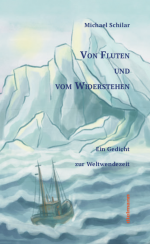
Of Floods and of Resistance (Von Fluten und vom Widerstehen)
Poem for the turning point of the world (Ein Gedicht zur Weltwendezeit)
- Flap broschure
- 324 pages
978-3-86638-502-3

»A Poem for the turning point of the world« – is the title Michael Schilar gives to his long, epic-dramatic poem, in which a painter travels to Greenland to preserve the ice in art before it disappears even more. What's more, he dreams of salvation for the ice and also for us humans, salvation that should be linked precisely to the effects of the hoped-for painting. The man fails off the coast of Greenland – was his ambition an illusion from the outset? And what are the sources of possible salvation?
The melting ice colossus, which the painter-skipper observed from the sea and later wanted to immortalize in a painting, had called out to him shortly before it collapsed on top of him:
Ein Geschehen, katastrophisch –
Ja, es scheint dir zugedacht.
Ist dein Tod auch philosophisch,
Trifft er doch mit ganzer Macht!
Despite the failure of this important protagonist in the poem, overall it is one thing above all else: a continuous search and quest for ways out of tragic developments. It thus describes certain approaches to solving the climatic and ecological crisis. These lie in the realm of technology and the reshaping of nature, fundamental social changes, including the concept of law (here with the idea of legal relationships that include nature and its phenomena), cultural memory, and art. At the end of the poem, the battered elements, especially the waves and wind, advise the procession of people walking along the seashore of the following message:
Doch ihr könnt‘s! Bezähmt die Geister,
Die ihr selbst gerufen habt!
Zauberlehrling, werde Meister,
Denn du bist dazu begabt!
»Von Fluten und vom Widerstehen« (Of Floods and of Resistance) deals with a very contemporary theme in a linguistic style reminiscent of earlier eras, specially in Enlightenment traditions, as if there were still relevant intellectual and moral standards to be gained today. The poem consists of three parts, which first describe the path of the painter-skipper and then that of a wanderer and another painter—in the latter case in connection with a developing nature- and climate-conscious human society. It consists mainly of rhyming quatrains, but the smaller second part is written in free rhythms. In both forms, the verses seem to echo the steady rhythm of the waves, as if the whole poem were subject to it.
We would like to thank Lea Reusse for the cover design.