Keep looking!

Strange, isn’t it: We have more, much more to do than before Corona. We realized all books planned, even 3 additional titles. Everything has changed, all that has been learned in 27 years of publishing is totally new each day.—Are we prepared to the New? And wasn’t it exactly the New, the curiosity about »News« that inspired the founding of a… MORE



Authors & Books
Béltrand Skármeta Boisier

Beltrán Skármeta Boisier, born in 1966, is an exiled Chilean, a poet since his youth, and says of himself that he has been trained »in being in a foreign country, in Sufism and the pure teachings of Christ«. He previously published the thematically related philosophical cycle of his »LeVitationen« (volumes I-III) between 2012 and 2015.—We are preparing the publication of his other poems.
Beltrán Skármeta Boisier lives and works in Berlin.

978-3-86638-497-2

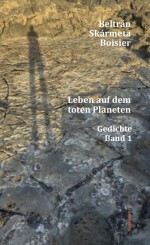
Life on The Dead Planet (Leben auf dem toten Planeten)
Poems, Volume 1
- Softcover
- 240 pages
978-3-86638-472-9
The first volume of a compilation of all the author's scattered poems: inspirations beyond the major works »Hier Und Da« (Here and There) and »LeVitationen« (LeVitations) by the exiled Chilean-born and widely traveled spiritual poet. They reflect the experience of exile and exclusion, epochal ecological failures, and what the author sees as a misguided understanding of »spirit« and wealth in today’s Western culture. These are accompanied by other poems, some of which are euphoric, testifying to an unshakeable belief in the spiritual powers that define human beings as such. Often precisely those who are seen as losers.
Was tat’sächlich
Dich am Leben hält,
Das ist die Nachsicht
Der vermeintlich Schwachen,
Die dich könnten anklagen
Und es ‘nicht ‘tun.

DIMAS. One Cross Further. (DIMAS. Ein Kreuz weiter.)
Philosophical Note on »Here and There.« (Philosophische Notiz zu »Hier Und Da.«)
- 88 pages
- Softcover
978-3-86638-426-2
DIMAS formulates in sharp sentences a doctrine of truth that accompanies the recently published long poem/drama »Hier Und Da« (Here and There) by the poet Beltrán Skármeta Boisier (see below). In it, the author has traced the fundamental »mind-sets« in which the world has been viewed and shaped from the oldest traditions to our own uncertain future. Rarely in favor of the unfortunate and the destitute.
Without ignoring controversial contemporary issues, this slim volume reads like a manifesto of mystical fire that dispels the »myth of reality«: what is reality when one truly believes and lives accordingly? A condensed reference to the author's previously published three-volume »LeVitations«, which is also helpful for those new to the subject.
Now cooler, using means other than his multi-layered art of writing verses, Skármeta Boisier attempts in DIMAS to reconnect with the infinite, which his magnum opus formally performs. The 134 sections of this treatise-like volume explore precisely this between the beginning of the first sentence, »Gesetzt den Fall, Gott ist wirklich« (Suppose God really exists), and the end of the last paragraph: how we can »über die letzten Hindernisse klimmen« (climb over the last obstacles).
Here is the blurb for his two previous titles with us.

Here And There (Hier Und Da)
The Great Disappearance – Long Poem & Drama (Das Große Verschwinden – Langgedicht & Drama)
- Hardcover
- With bookmark
- 272 pages
- A special edition will be published
978-3-86638-434-7
In a formally highly elaborate epic long poem, Beltrán Skármeta Boisier traces the fundamental mindsets in which the world has been viewed and shaped from the oldest traditions to our own uncertain future—rarely to the benefit of the unfortunate and destitute, but rather, as a rule, at their expense.
Skármeta Boisier aims both at the reading and the performance of his long poem. Based on the declamation and acting practices of the theater of early ancient Greek, interspersed with transcendental poetry whose grace and power are moving. The 11 »hearings« therefore also contain detailed instructions and text markings. Presented by individual archaic to enigmatic figures and choir groups, the long poem, in contrast to the simplification noted by Walter Höllerer with regard to Bob Dylan’s »Long Poems«, for example, approaches an almost operatic musical notation.
În ‘den ~ Gefängnissen des Wissens, das ver*spricht …
Das Spiel ist *alt, der Schädel mahlt.
Schon gêstern ‘werden wir die Zeit vermissen,
Die da ‘kommt, wenn wir beharren
Auf den *Zahn und jêden Bissen
In various eras and regions of human civilization, whose respective poetic habits are recreated, a position of evil that has been completely overlooked in contemporary literature comes into effect—a powerful stage unfolds before us in Faustian fashion. For now, it can be read between the covers of two books.
The painter Wolfgang H. Scholz contributed eight illustrations to the volume: Born in Dresden-Blasewitz in 1958, Scholz studied painting and graphic design at the HfBK Dresden. In 1994, he co-founded Sic! Film Produktions GmbH in Munich, and since 1992, he has been an editor/director for Bayerischer Rundfunk (television), ZDF, MDR, ORF, ARTE, and others. He is a member of the Saxon Academy of Arts and lives in Mexico City and Munich.